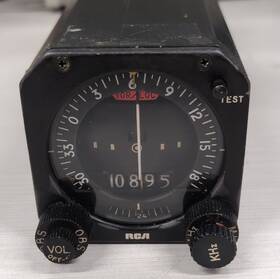
( Brand: Rca ), ( Manufacturer Part Number: AVN-211 ), ( Part Type: Aviation )
Review RCA Vhf Nav System Aviation Equipment
The **RCA AVN-211 VHF NAV MI-585077-3** is a high-performance, military-grade VHF navigation receiver designed for precision aircraft navigation, communication, and situational awareness in demanding aviation environments. Engineered with robust reliability and advanced signal processing, this unit is a critical component in modern military and commercial aircraft systems, ensuring seamless integration with existing avionics suites. Built to exacting military specifications, the AVN-211 excels in both VHF navigation and communication functions, providing pilots with accurate and real-time data for safe and efficient flight operations. Its compact yet durable construction allows for easy installation in tight aircraft compartments, while its ruggedized design ensures resilience against harsh environmental conditions, including extreme temperatures, vibration, and electromagnetic interference. The MI-585077-3 variant, in particular, is a refined model optimized for compatibility with specific aircraft platforms, offering enhanced performance in crowded airspace or high-noise environments. With its ability to receive and decode VOR (VHF Omnidirectional Range), ILS (Instrument Landing System), and other critical navigation signals, this receiver enables pilots to maintain precise positioning, approach guidance, and emergency navigation capabilities. Whether deployed in fighter jets, transport aircraft, or specialized mission platforms, the RCA AVN-211 delivers uncompromising accuracy and dependability, making it an indispensable tool for military aviators worldwide. Its modular design also facilitates easy upgrades and maintenance, ensuring long-term operational efficiency.
The RCA AVN-211 VHF NAV MI-585077-3 is a vintage aircraft navigation receiver designed for VHF (Very High Frequency) communication and navigation, commonly used in older general aviation aircraft. Below is a detailed breakdown of its pros and cons, followed by a conclusion and recommendation.
---
### **Pros of the RCA AVN-211 VHF NAV MI-585077-3**
1. **Compatibility with Older Aircraft**
The AVN-211 is a well-documented and widely used unit in classic aircraft such as the Cessna 172, 182, and other models from the mid-20th century. If your aircraft was originally equipped with this model, replacing a failing unit with an identical or compatible one ensures seamless integration without the need for additional modifications.
2. **Reliability and Durability**
RCA (now part of GE Aviation) was a trusted manufacturer of aviation electronics, and the AVN-211 was built to withstand the rigors of aircraft environments. Many units from this era have proven to be robust, especially if they were well-maintained. Some owners report decades of trouble-free service with minimal wear.
3. **Availability of Parts and Support**
Due to its age, the AVN-211 has a large user base, which means parts (such as knobs, switches, and wiring harnesses) are relatively easy to find, especially through aviation surplus vendors or eBay. Additionally, there are numerous forums (e.g., AvionicsBay, Aircraft Spruce, and vintage aviation groups) where owners share troubleshooting tips, schematics, and repair guides.
4. **Mechanical Tuning and Simplicity**
The AVN-211 uses a mechanical tuning dial, which some pilots prefer for its tactile feedback and simplicity. Unlike modern digital units, it lacks complex software or touchscreens, reducing the risk of electronic failure. This can be advantageous in older aircraft where redundancy and simplicity are valued.
5. **Low Power Consumption**
VHF NAV receivers like the AVN-211 typically draw minimal power, making them suitable for aircraft with limited electrical systems. This can be particularly useful in light aircraft or those with older electrical setups.
6. **Compatibility with VOR and Localizer Signals**
The AVN-211 is designed to receive VOR (VHF Omnidirectional Range) and localizer signals, which are essential for navigation in IFR (Instrument Flight Rules) conditions. Its performance in this regard is well-documented and reliable for its era.
7. **Resale Value for Classic Aircraft**
If you own or operate a vintage aircraft, the AVN-211 may retain value as an original or replacement part. Some collectors or restorers prefer authentic components, which can make the unit easier to sell or trade in the future.
8. **No Dependency on Modern Technology**
Unlike newer avionics that rely on GPS, ADS-B, or digital interfaces, the AVN-211 operates independently. This can be a plus in situations where modern systems might fail or become obsolete, or if you prefer to avoid integrating complex electronics into your aircraft.
---
### **Cons of the RCA AVN-211 VHF NAV MI-585077-3**
1. **Age and Potential Wear**
The AVN-211 is a vintage unit, and like all electronics, it is subject to wear and tear over time. Components such as capacitors, resistors, and wiring can degrade, leading to intermittent failures or complete loss of function. Older units may require thorough inspection and testing before installation.
2. **Limited Modern Features**
The AVN-211 lacks modern conveniences such as:- **Digital tuning** (all mechanical).
- **Frequency memory or presets** (must be tuned manually).
- **Integration with modern avionics** (e.g., GPS, ADS-B, or glass cockpits).
- **Automatic frequency scanning or alerts**.
This can be cumbersome for pilots who rely on quick access to frequencies or automated systems.
3. **Maintenance and Repair Challenges**
While parts are available, repairing the AVN-211 may require specialized knowledge of vintage avionics. If you lack experience in electronics or avionics, you may need to hire a professional, which can be costly. Additionally, finding a technician familiar with this specific model may be difficult in some regions.
4. **Potential for Interference or Drift**
Mechanical tuning units can suffer from tuning drift over time, meaning the frequency may not stay accurately set. Environmental factors such as temperature changes or vibration can also cause performance issues. Some users report needing to periodically recalibrate the unit.
5. **No Built-in Test Equipment**
Unlike modern avionics, the AVN-211 does not have built-in diagnostics or self-tests. Troubleshooting a malfunctioning unit may require external test equipment (such as a frequency counter or signal generator) to isolate the problem.
6. **Limited Lifespan of Original Components**
Internal components like the tuning capacitor, coils, and transistors may eventually fail. While replacements exist, they may not be as readily available as they were decades ago. Some critical parts (e.g., specific transistors or capacitors) may need to be sourced from obsolete suppliers.
7. **Compatibility with Modern Aircraft Systems**
If your aircraft has been modified with modern avionics (e.g., glass cockpits, ADS-B, or digital interfaces), integrating the AVN-211 may require additional wiring or adapters. This can add complexity and cost to the installation.
8. **Regulatory and Certification Considerations**
While the AVN-211 is FAA-certified for its intended use, using a vintage unit may raise questions during inspections or maintenance checks. Some inspectors may prefer more modern, easily replaceable equipment. Additionally, if the unit has been heavily modified or repaired, it may need to be recertified or logged by an A&P mechanic.
9. **Limited Warranty or Support**
Since the AVN-211 is no longer in production, there is no manufacturer warranty or customer support. Any issues must be resolved through third-party vendors or community knowledge, which can be hit-or-miss.
10. **Potential for Obsolescence**
As aviation technology evolves, older units like the AVN-211 may become less practical, especially if you plan to upgrade your aircraft s avionics suite. Modern VHF NAV receivers often include additional features (e.g., GPS integration, ADS-B in, or digital displays) that may be desirable in the future.
---
### **Conclusion**
The RCA AVN-211 VHF NAV MI-585077-3 is a solid choice for pilots operating vintage aircraft where compatibility, simplicity, and reliability are prioritized. Its mechanical design and proven track record make it a trusted workhorse for classic aviation. However, its age introduces challenges such as limited modern features, potential maintenance issues, and the need for specialized knowledge to keep it running smoothly.
If you are restoring or maintaining an older aircraft and the AVN-211 is the original or a direct replacement, it can be a cost-effective and reliable option. On the other hand, if you are looking for a more modern, feature-rich, or easier-to-maintain VHF NAV receiver, newer units (such as the Garmin GNC 255 or Bendix/King KX 155) may be more suitable.
---
### **Recommendation**
1. **Buy the AVN-211 if:**- You are restoring or maintaining a vintage aircraft that originally came with this unit.
- You prefer mechanical tuning and simplicity over digital features.
- You are comfortable with basic avionics maintenance or have access to a knowledgeable technician.
- You can source a unit that has been thoroughly tested and is in good working condition (preferably with a history of maintenance).
- You do not plan to integrate modern avionics and are satisfied with its basic functionality.
2. **Consider a Modern Alternative if:**- You want digital tuning, frequency memory, or integration with GPS/ADS-B.
- You prioritize ease of use, diagnostics, and modern features.
- You are operating a newer aircraft or plan to upgrade your avionics suite in the future.
- You lack experience with vintage avionics and prefer a unit with wider support and warranties.
- You want to avoid potential maintenance headaches associated with older electronics.
3. **Before Purchasing:**- Inspect the unit thoroughly for signs of wear, corrosion, or damage.
- Test it with a known frequency to ensure it tunes correctly and receives signals.
- Check for any known issues or common failures associated with this model (e.g., capacitor leaks, loose connections).
- Verify compatibility with your aircraft s wiring and power supply.
- Consider purchasing from a reputable seller (e.g., AvionicsBay, Aircraft Spruce, or a trusted private seller) who can provide documentation or a brief history of the unit.
Ultimately, the AVN-211 is a great choice for enthusiasts of classic aviation, but it may not be the best long-term solution for pilots seeking modern convenience or those operating more contemporary aircraft. Weigh your priorities carefully before making a decision.
Details:
Status unknown sold as is.
part #: avn211 prices
- $124.99-$225.24
specifications comnavavioni:
- brand: Rca
- mpn: Avn-211
- part type: Aviation
shipping comnavavioni:
- transit: 3-9 Days
- cost: $15.93
- carrier: UPS
- service: UPS Ground
- type: Calculated
- class: Standard
payments comnavavioni:
- credit card: Visa
- other
- wallet: Apple-pay
offer comnavavioni:
- options: Ship-to-home
- availability: In Stock
- best offers: True
- started: April 29, 2026
- quantity: 1
- sold: 0
seller comnavavioni:
- rating: 0.0%
- # reviews: 0
- city: Wadsworth, Ohio
general comnavavioni:
- condition: For parts or not working
- Aviation Parts Accessories > Avionics > NAV/COMs
returns comnavavioni:
- policy: No Returns
Rca AVN-211 Is Similar To:
- Mi 591038 Rca Aviation Equipment Avq-55 Weather (41.5% similar) No warranty. Has slight rub hole on exterior of case as shown in photo. Unit worked when removed from aircraft...(March 9th, 2017)
- 49250-1000 Mid Continent Cessna Rca Rt485b Nav Com P N With Tray (24.4% similar) Mid continent instrument co...(April 28th, 2016)
- Rca Avq-75 Dme Interrogator Aviation Distance Measuring Equipment Avionics (45.1% similar) Mechanically, the arm that is left of antenna outlet locked into its horizontal position. Cosmetically, the unit appears to be in good shape with no major issues noted. Rca AVQ-75 Dem interrogator distance measuring equipment in untested as-found condition. Rca aviation equipment. The arm on right ...(September 30th, 2018)
- Mi-585073 Avn-220a Rca Nav (32.9% similar) Unit sold as is...(May 12th, 2016)
- Rca Mi-585032 P n Avn-221 Vhf Nav System Mods 1-3 (53.7% similar) From my dads vast acmes avionics collection...(January 22nd, 2026)
- Rca Avn-212 Vhf Nav System (58.8% similar) Status unknown sold as is...(April 29th, 2026)