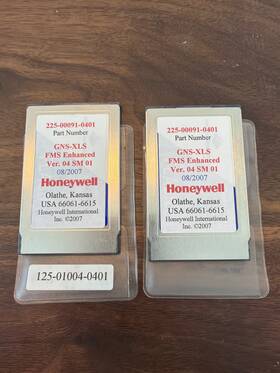
( Brand: Honeywell ), ( Part Type: Aviation Card ), ( UPC: 225000910401 )
Review HONEYWELL Gns xls Fms Datacards Aviation Lot Cards fits XLS
The **Honeywell 225-00091-0401 GNS-XLS FMS Datacards** are essential components designed to enhance the functionality and precision of the Honeywell GNS-XLS Flight Management System (FMS), a cutting-edge navigation and flight management solution trusted by pilots in both general aviation and commercial operations. These high-quality datacards serve as the digital backbone of the GNS-XLS, storing critical flight planning, navigation, and performance data required for seamless in-flight operations. Engineered with Honeywell s rigorous standards, these cards are built to withstand the demanding conditions of aviation environments, ensuring reliability and durability even in the most challenging flight scenarios. Each datacard is pre-loaded with the latest aeronautical databases, including detailed airport information, approach procedures, en route charts, and performance data, all meticulously updated to comply with the latest FAA, ICAO, and other regulatory standards. The cards are compatible with the GNS-XLS s advanced flight management capabilities, enabling pilots to access real-time navigation, terrain awareness, and weather updates with unmatched accuracy. Whether used for short-haul regional flights or long-distance cross-country journeys, these datacards provide pilots with the confidence of having up-to-date, authoritative information at their fingertips, reducing the risk of errors and improving overall flight efficiency. The seamless integration with the GNS-XLS ensures that pilots can focus on safe and efficient navigation without the need for manual data entry or outdated paper charts. For aviation professionals who demand precision, reliability, and cutting-edge technology, the Honeywell 225-00091-0401 GNS-XLS FMS Datacards are an indispensable tool, bridging the gap between advanced avionics and real-world flight operations.
### **Pros and Cons of Buying Honeywell 225-00091-0401 GNS-XLS FMS Datacards**
#### **Pros:**1. **Compatibility and Functionality** These datacards are designed specifically for the Honeywell GNS-XLS Flight Management System (FMS), ensuring seamless integration with navigation, approach, and performance databases. They provide accurate and up-to-date aeronautical information, including airport data, airways, and instrument approaches.
2. **Regulatory Compliance** The datacards are certified and approved for use in commercial and private aviation, meeting FAA and other regulatory requirements. This reduces the risk of non-compliance or operational issues during flights.
3. **Convenience and Portability** Datacards are compact and easy to store, eliminating the need for bulky paper charts or external USB drives. They can be quickly swapped between aircraft equipped with the same FMS system.
4. **Automatic Updates** Honeywell periodically releases updated datacards to incorporate changes in airspace, procedures, and navigation aids. Buying from an authorized source ensures access to the latest versions without manual updates.
5. **Cost-Effective for Long-Term Use** While the initial purchase may seem expensive, datacards are a one-time investment (for a specific version) that eliminates recurring costs associated with paper charts or subscription-based digital databases.
6. **Reduced Cognitive Load** Pilots rely on the FMS for navigation, reducing the need to manually reference paper charts, which can improve situational awareness and efficiency.
7. **Support for Advanced Features** The GNS-XLS FMS supports advanced functionalities like direct-to navigation, RNAV approaches, and performance calculations, which are only possible with the correct datacard installed.
---
#### **Cons:**1. **High Initial Cost** The upfront cost of purchasing these datacards can be prohibitive, especially for private pilots or small operators. The price varies depending on the version (e.g., IFR, IFR ), and bulk purchases may be required for commercial operators.
2. **Version Dependency** Datacards are version-specific (e.g., IFR, IFR , or regional editions). Purchasing the wrong version may render the card incompatible with the aircraft s FMS, requiring an additional purchase. Outdated versions can also lead to navigation inaccuracies or missed updates.
3. **Limited Lifespan** While datacards are durable, they are not indestructible. Physical damage (e.g., from moisture, extreme temperatures, or rough handling) can render them unusable. Some pilots opt for backup cards to mitigate this risk.
4. **No Automatic Updates Without Purchase** Unlike subscription-based digital databases (e.g., ForeFlight or Garmin Pilot), datacards require manual replacement when Honeywell releases new versions. This means pilots must proactively check for updates and budget for replacements.
5. **Dependence on Honeywell s Release Cycle** Honeywell s update schedule may not align with a pilot s needs. Major updates (e.g., for new airports or procedures) could arrive at inconvenient times, requiring immediate replacement.
6. **Potential for Counterfeit or Unauthorized Copies** Purchasing from unauthorized sellers may result in counterfeit or pirated datacards, which could fail certification checks or cause FMS malfunctions. Only official Honeywell distributors or approved retailers should be used.
7. **No Integration with Third-Party Apps** Unlike modern digital databases, datacards do not sync with mobile apps or other navigation tools. Pilots must rely solely on the FMS for navigation, which may limit flexibility in pre-flight planning.
8. **Storage and Organization Challenges** Managing multiple datacard versions (e.g., IFR, IFR , regional) can be cumbersome. Pilots must ensure the correct card is installed for each flight, which adds a layer of administrative work.
---
### **Conclusion:**The **Honeywell 225-00091-0401 GNS-XLS FMS datacards** are a reliable and efficient solution for pilots using the GNS-XLS system, offering precise navigation data, regulatory compliance, and long-term cost savings. However, their high upfront cost, version-specific nature, and lack of automatic updates present challenges, particularly for pilots who prefer flexibility or subscription-based updates.
For **commercial operators or pilots who prioritize reliability and regulatory adherence**, these datacards are a worthwhile investment. For **private pilots or those who frequently fly in diverse regions**, the cost and version management may outweigh the benefits, making alternative solutions (e.g., ForeFlight, Garmin Pilot, or paper charts) more practical.
---
### **Recommendation:**- **Buy from an authorized Honeywell distributor** to ensure authenticity and avoid counterfeit cards.
- **Verify the correct version** (IFR, IFR , or regional) before purchasing to match your aircraft s FMS requirements.
- **Budget for periodic replacements** based on Honeywell s update schedule, especially if you fly frequently or in regions with frequent airspace changes.
- **Consider a backup datacard** to mitigate risks from physical damage or version mismatches.
- **Evaluate alternatives** if cost or update management is a concern. Subscription-based digital databases (e.g., ForeFlight) may offer more flexibility for pilots who value real-time updates and app integration.
**Final Verdict:** If you are committed to the GNS-XLS system and can manage the costs and versioning, these datacards are a solid choice. Otherwise, explore hybrid solutions (e.g., using datacards for IFR flights and digital apps for VFR) to balance reliability and convenience.
Details:
04 SM 01, Honeywell GNS-XLS FMS ENHANCED DATA CARD.
part #: 225000910401 price
- $200.00
specifications comnavavioni:
- for models: Xls
- brand: Honeywell
- part type: Aviation Card
- upc: 225000910401
seller comnavavioni:
- rating: 100.0%
- # reviews: 467
- city: Ocala, Florida
payments comnavavioni:
- credit card: Diners-club
- other
- wallet: Google-pay
general comnavavioni:
- Aviation Parts Accessories > Avionics > NAV/COMs
- condition: Used
returns comnavavioni:
- policy: No Returns
shipping comnavavioni:
- class: Economy
- service: UPS Ground Saver
- transit: 7-14 Days
- carrier: UPS
- cost: $28.52
- type: Calculated
offer comnavavioni:
- started: May 13, 2026
- availability: In Stock
- best offers: True
- quantity: 1
- sold: 0
- options: Ship-to-home
Honeywell 225-00091-0401 Is Similar To:
- 006-0914-00 Honeywell Bendix Aviation Division Flight Control System Installation Manual (35% similar) Honeywell Bendix FCS-810 flight control system installation manual brand: aviation division manufacturer part number. Inc: c, I condition: in great used condition...(October 6th, 2018)
- 066-3034-06 Bendix-king-honeywell Ki-207 P-n With (26.4% similar) El Pasco aery, inc. 895 outright. This item has recently been repaired, tested and inspected by the el Pasco aery avionics department a fresh exchange...(September 15th, 2017)
- 17960-0102-0001 Honeywell Fms Flight Navigation Management Aviation (38.8% similar) Selling as is. Please see pictures for details also, feel free to ask any questions pertaining this item. X2 Honeywell gns-xls fms flight management system used and untested due to lack of equipment. Free shipping only applies to the 48 contiguous states. Good cosmetic condition...(April 5th, 2019)
- 17960-0102-0002 Honeywell Fms Flight Management System (30.2% similar) Honeywell gns-xls finespun: a 105B. Please see pictures for details also, feel free to ask any questions pertaining this item. It is not FAA certified. Please review photos for full product condition, details, and. Sold as pictured. It seems to be in fair condition. White lighting. Honeywell gns-xls...(March 25th, 2019)
- 17960-0102-0003 Honeywell Gns-xls Fms Xls (40.7% similar) ...(February 11th, 2017)
- 17960-0102-003 Honeywell 17960-0102-0003 Gns-xls-fms Flight (42.7% similar) 5 nominal w x 6a nominal, VA max inputs: analog digital - fuel flow, air data, heading, weather radar, efi, cor Dem demotivates: efi flight director, autopilot, radio tuning long range sensors:internal GPS, Tao C129 class a1 b1 3 irenic 429 ports, 1/5 71 portages interface:includes coverage for both...(December 1st, 2017)
- 17960-0103-0001 Honeywell Fms Flight Navigation Management Aviation (38.8% similar) Good cosmetic condition. Selling as is. Honeywell gns-xls fms flight navigation management used and untested due to lack of equipment. Free shipping only applies to the 48 contiguous states. Please see pictures for details also, feel free to ask any questions pertaining this item...(April 5th, 2019)
- 17960-0203-0101 Honeywell Gns-xls (32.4% similar) Repaired by Honeywell, still in box...(July 20th, 2017)
- 17960-0204-0115 Honeywell Fms (25.7% similar) Used Honeywell gns-xls fms model: in great condition. Does not come with a tag but my father mechanic and over 3500 hours ck time has flown this plane fms can answer any questions you might have...(March 12th, 2019)
- 17960-0102-0004 Honeywell Gns-xls Fms As Removed 30 Days Warranty 2000 Outright (39.7% similar) Regardless of the fact that there are logbooks out there that are full of them, the term yellow tag isn't mentioned anywhere in far part 43. Most of us would have picked the color green for serviceable and yellow for repairable not the other way around. Avionics masters our name says it all. For ...(April 6th, 2016)
- 7510700-806 Honeywell With (28.6% similar) Unit is returnable for full credit if uninstalled and factory inspection seals are intact...(October 8th, 2018)