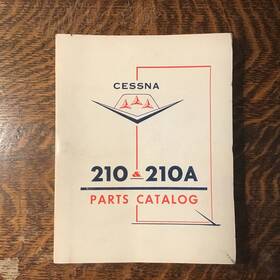
( Manufacturer Part Number: 210-210A ), ( Part Type: Manual ), ( Country Of Origin: United States )
Review CESSNA 210 And 210a Parts Manual
The **Cessna 210 Centurion** and its refined successor, the **Cessna 210A Centurion Stationair**, represent a milestone in the evolution of high-performance, single-engine piston aircraft, blending rugged utility with sophisticated aerodynamics and cutting-edge avionics. Introduced in the late 1950s as a response to the demands of general aviation pilots seeking greater speed, comfort, and versatility, the 210 series quickly established itself as a workhorse for private owners, flight schools, and commercial operators alike. Its distinctive **T-tail design** not only enhances stability and control at low speeds critical for short-field operations but also provides an unobstructed view from the cockpit, reducing pilot workload during critical phases of flight. The **210A variant**, introduced in 1962, refined the original with improved fuel efficiency, a more powerful **285 horsepower Continental IO-520-F engine** (or the optional **Lycoming IO-520-G**), and enhanced structural integrity, making it a favorite among pilots who demand reliability without sacrificing performance. The aircraft s **high-wing configuration** ensures excellent visibility and stability, while its **retractable tricycle landing gear** (standard on most models) allows for smoother takeoffs and landings, reducing ground shock and improving efficiency.
Mechanically, the Cessna 210A is a study in engineering pragmatism, featuring a **semi-monocoque fuselage** constructed from high-strength aluminum alloys, designed to withstand the rigors of frequent takeoffs, landings, and crosswind operations. The **wing design**, with its **NACA 23012 airfoil**, optimizes lift and drag characteristics, enabling the aircraft to achieve a **cruise speed of approximately 180 knots (207 mph)** while maintaining a **service ceiling of 21,000 feet**, making it capable of crossing state lines or even short regional hops with ease. The **fuel system** is equally robust, with **two 56-gallon tanks** (totaling 112 gallons usable fuel) that provide an impressive range of **1,000 nautical miles** at economical cruise speeds, a boon for pilots planning multi-day missions or remote operations. The **avionics suite** in the 210A has evolved significantly over the years, with modern installations often featuring **GARMIN G3X or Garmin G5 panels**, offering **primary flight displays (PFD), multi-function displays (MFD), and advanced navigation capabilities**, including **WAAS GPS, terrain awareness, and traffic collision avoidance systems (TCAS)**. For those who prefer analog instrumentation, the classic **6-pack setup** remains an option, though it is increasingly supplemented with modern glass cockpits for enhanced situational awareness.
The **cockpit of the Cessna 210A** is a testament to Cessna s commitment to pilot comfort and efficiency, with **ergonomic controls**, **adjustable seats**, and **large, unobstructed windows** that minimize pilot fatigue during long flights. The **dual controls** make it an ideal training aircraft, while the **spacious cabin** with seating for up to **four passengers** offers a surprisingly roomy interior for its size, complete with **folding seats** that can be reconfigured for cargo or additional baggage space. The **pressurization system** (available as an option on some models) further enhances comfort during high-altitude flights, reducing the effects of cabin altitude on passengers. Maintenance and operational flexibility are further enhanced by the **210A s modular design**, which allows for easy access to critical systems, including the **fuel injectors, carburetor (if equipped), and engine components**, all of which contribute to its reputation as a **low-maintenance, high-reliability aircraft**. The **210 series manuals**, including the **Pilot s Operating Handbook (POH), Maintenance Manual, and Service Information**, are meticulously detailed, providing pilots and mechanics with step-by-step procedures for everything from **pre-flight inspections and emergency procedures** to **engine overhauls and structural repairs**. These manuals are not merely instructional guides but **comprehensive references** that reflect the aircraft s enduring legacy as a **self-sufficient, adaptable machine** capable of handling everything from routine cross-country flights to demanding utility missions.
Beyond its technical specifications, the Cessna 210A holds a special place in aviation history as a **bridge between the classic piston-era aircraft and the modern glass-cockpit era**. Its **durability, versatility, and proven performance** have earned it a devoted following among pilots who value **raw capability without unnecessary complexity**. Whether used for **private travel, flight instruction, aerial photography, or even light utility work**, the 210A delivers a **smooth, responsive flight experience** that is both **capable and forgiving**, making it an excellent choice for pilots of all skill levels. For those seeking to maintain or restore one of these aircraft, the **Cessna 210/210A manuals** serve as an indispensable resource, offering **detailed schematics, troubleshooting guides, and maintenance schedules** that ensure the aircraft remains airworthy for decades to come. From the **rustling of the fabric wings** to the **purr of the Continental or Lycoming engine**, the Cessna 210A embodies the spirit of classic aviation **powerful, practical, and endlessly capable**.
### **Pros and Cons of Buying a Cessna 210 (Including 210A Models)**
The Cessna 210 series, particularly the **210 and 210A**, is a popular high-wing, single-engine, four-seat aircraft known for its versatility, performance, and durability. Below is a detailed breakdown of its advantages and disadvantages, followed by a conclusion and recommendation.
---
### **Pros of Buying a Cessna 210/210A**
1. **Reliability and Durability**
- The Cessna 210 has a strong reputation for longevity, with many aircraft exceeding **10,000 hours** of flight time.
- The airframe is robust, built to withstand rough landings and adverse conditions, making it ideal for general aviation pilots who may fly in varied weather or terrain.
- Many 210s were originally built for agricultural use, which reinforced their structural integrity.
2. **Performance and Speed**
- The **210A** (with a **210 hp Continental IO-470-K or Lycoming O-470-K engine**) offers better performance than earlier models, with a **cruise speed of 160 180 knots** (depending on weight and configuration).
- The **210** (with a **200 hp engine**) is slightly slower but still capable of ** 140 160 knots** cruise.
- Both models have a **high climb rate**, making them suitable for short-field operations and mountain flying.
3. **Fuel Efficiency and Range**
- The 210 series has **excellent fuel efficiency** for its class, burning ** 12 15 gallons per hour** (depending on power setting).
- With a **standard fuel capacity of 80 gallons**, it can achieve a **range of 600 800 nautical miles** at economical cruise speeds, making it great for cross-country flights.
- Some models (especially the **210A**) can be fitted with **longer-range tanks**, increasing endurance.
4. **Versatility and Utility**
- The **high-wing design** provides excellent visibility and stability, making it easy to fly in rough air or during instrument approaches.
- The **fixed-pitch or constant-speed propeller** options allow pilots to choose based on performance needs.
- The **agricultural heritage** means many 210s are equipped with **utility features** (e.g., heavy-duty landing gear, optional skis, or floats), making them adaptable for various missions.
- Some 210s are used for **aerial photography, surveying, or even light cargo transport**, expanding their utility beyond personal flying.
5. **Maintenance and Availability of Parts**
- As one of the most common GA aircraft, **spare parts are widely available** and often **affordable**.
- The **mechanical simplicity** of the 210 (compared to modern glass cockpits) means **easier and cheaper maintenance** than newer models.
- Many **pilots and mechanics** are familiar with the 210, reducing the learning curve for upkeep.
- The **Continental IO-470 and Lycoming O-470 engines** (common in the 210A) are well-supported and have a strong aftermarket.
6. **Resale Value and Community**
- The Cessna 210 holds its value well compared to many other GA aircraft, especially well-maintained examples.
- There is a **strong owner community**, with forums (e.g., **Cessna 210 Owners Group on Facebook, AVweb forums**) providing support, modifications, and troubleshooting advice.
- Many **flight schools and charter operators** use 210s, ensuring a steady supply of used aircraft.
7. **Comfort and Spacious Cabin**
- The **four-seat cabin** is roomy compared to some single-engine aircraft, with **good headroom** and **comfortable seating**.
- The **high-wing design** reduces wind noise inside the cabin, making for a quieter flight experience.
- Some owners have **modified interiors** for additional storage or comfort.
8. **Cost-Effective Ownership**
- **Purchase price** is relatively reasonable compared to newer high-performance singles (e.g., Cirrus SR20, Piper Archer).
- **Operating costs** (fuel, maintenance, insurance) are lower than many alternatives in its class.
- The **low hourly operating cost** makes it attractive for **flight training, charter, or personal use**.
---
### **Cons of Buying a Cessna 210/210A**
1. **Aging Airframe and Potential Structural Issues**
- Many 210s were built in the **1960s 1980s**, meaning some may require **major inspections or repairs** (e.g., **wing ribs, control surfaces, or fuselage corrosion**).
- **Fatigue cracks** can develop in older airframes, particularly around **wing roots, fuselage joints, and control linkages**.
- **ADs (Airworthiness Directives)** may apply, requiring compliance (e.g., **wing rib inspections, control surface adjustments**).
2. **Engine Reliability Concerns**
- The **Continental IO-470 and Lycoming O-470 engines** (common in the 210A) are **powerful but prone to issues** if not properly maintained.
- **Common problems** include:- **Cylinder head cracks** (especially in older IO-470s).
- **Rod bearing wear** (Lycoming O-470s are known for this).
- **Fuel injection or carburetor icing** (if equipped).
- **Overhauls can be expensive** ($15,000 $30,000 ), and finding **reliable used engines** can be challenging.
- Some owners opt for **turbocharging** (if not already installed) to improve high-altitude performance, but this adds complexity.
3. **High Power Settings Can Be Demanding**
- The **210A s 210 hp engine** is **strong but can be punishing** if not managed properly.
- **Propeller torque** can cause **nose-heavy handling**, requiring careful trim adjustments.
- **Takeoff and landing performance** is excellent, but **rough landings** can stress the airframe if not executed properly.
4. **Limited Modern Avionics Options**
- Many 210s come with **analog instrumentation**, which can be **less efficient and less safe** than modern glass cockpits.
- While **aftermarket GPS and autopilot installations** are possible, they require **additional wiring and certification**.
- **IFR (Instrument Flight Rules) equipment** may need upgrades, increasing costs.
5. **Fuel and Oil Consumption**
- The **210A burns more fuel** than smaller singles (e.g., Piper Archer, Cessna 172), which can add to operating costs.
- **Oil consumption** can be higher in some engines, requiring **frequent checks and top-ups**.
- **Fuel-stable storage** may be necessary if the aircraft is not flown regularly (to prevent fuel degradation).
6. **Weight and Performance Trade-offs**
- The **210 is heavier** than many training aircraft, which can **reduce maneuverability** and **increase takeoff/landing distances** on short runways.
- **Gross weight limitations** (typically **2,550 lbs**) mean **payload capacity is reduced** compared to larger aircraft.
- **Crosswind limitations** ( 15 18 knots) may be restrictive for some pilots.
7. **Maintenance Can Be Labor-Intensive**
- While parts are available, **some repairs require specialized knowledge** (e.g., **propeller balancing, engine overhauls, or structural work**).
- **DIY maintenance is possible** but may not be feasible for all owners, increasing reliance on mechanics.
- **Annual inspections** can be costly if the aircraft has **hidden issues** (e.g., corrosion, control surface adjustments).
8. **Noise and Vibration**
- The **Lycoming/Continental engines** are **loud and vibration-prone**, especially at higher power settings.
- Some owners report **excessive vibration** in the **210A s engine mounts**, requiring periodic adjustments.
- **Cabin noise** can be higher than in modern aircraft, making long flights less comfortable.
9. **Limited Comfort for Long Flights**
- While the cabin is spacious, **long cross-country flights** can be **less comfortable** than in pressurized or more modern aircraft.
- **Heating/cooling systems** may be basic, and **de-icing** (if equipped) can be an added expense.
10. **Insurance and Liability Risks**
- **Insurance premiums** can be higher than for smaller aircraft due to **higher power and potential for damage in rough landings**.
- **Accident rates** (while not inherently higher) may be influenced by **pilot experience**, as the 210 s performance requires **skilled handling**.
---
### **Conclusion**
The **Cessna 210/210
Details:
Made by the renowned brand Cessna in USA, this manual includes detailed information on manufacturer part numbers for specific components, ensuring that users can accurately identify and acquire necessary parts their aircraft.
part #: 210210a prices
- $64.71-$88.75
specifications comnavavioni:
- for makes: Cessna
- mpn: 210-210a
- part type: Manual
- country of origin: United States
offer comnavavioni:
- availability: In Stock
- started: March 30, 2026
- options: Ship-to-home
- sold: 0
- quantity: 1
seller comnavavioni:
- # reviews: 3319
- city: Savannah, Georgia
- rating: 99.4%
returns comnavavioni:
- time: 30 Days
- policy: Returns Accepted
- paid by: Buyer
general comnavavioni:
- condition: Used
- Aviation Parts Accessories > Avionics > NAV/COMs
shipping comnavavioni:
- transit: 4-10 Days
- class: Economy
- cost: $5.22
- carrier: USPS
- service: USPS Media Mail
- type: Calculated
payments comnavavioni:
- credit card: Visa
- wallet: Google-pay
- other
Cessna 210-210A Is Similar To:
- 140a Parts Manual Cessna Original (43.2% similar) This item is: original cessna 140A parts manual...(December 25th, 2017)
- 172sim Cessna 172s Skyhawk Information Manual (39.5% similar) Cessna 172S sky hawk information manual pn 172SIM in original packaging. Comes with pilot safety and warning supplements...(February 21st, 2017)
- 1978 Series Thru Parts Cessna 177rg 1971 Catalog (29.2% similar) ...(March 3rd, 2015)
- 180e Owners Manual Cessna 1962 (36.6% similar) ...(January 9th, 2018)
- 182f Owners Manual Cessna 1963 (36.6% similar) ...(October 30th, 2017)
- 185 Skywagon A185e Owners Manual Cessna For Sn 18501820 And (30% similar) This item is: cessna 185 sky wagon A185E owners manual for sn and on...(February 20th, 2017)
- 185a Owners Manual Cessna 1962 (33.8% similar) 8000 to 9000 avionic items in this store. This item is: 1962 cessna 185A owners manual...(January 12th, 2018)
- 1948 Cessna 190 195 Owners Operation Manual (50% similar) This item is: 1948 cessna owners operation manual...(March 30th, 2017)
- 1951 1952 Genuine Cessna Publication 170 Series Operation Owner S Ma Owners Manual 170a Original (35% similar) Genuine, original cessna 170 series operation manual in excellent condition. No disappointments here...(November 28th, 2015)
- 1953 Cessna 170 Owners Manual (57.1% similar) ...(March 29th, 2017)
- 1959-1969 Cessna 150 Parts Manual Rare 1959 Through 1969 Series Catalog (39.3% similar) Item is in fair to good condition and is a functional original manual. Impossible to find one at this price, so hurry before it is gone. Fantastic find from the estate of a retiring collector...(September 17th, 2016)