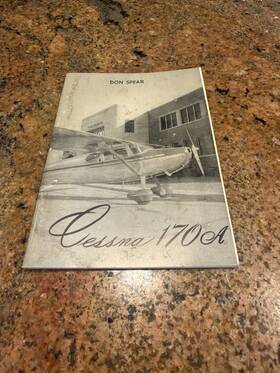
( Manufacturer Part Number: 170-170A ), ( Part Type: Manual )
Review CESSNA 170a Operation Owners Manual fits 1951–1952
The **Cessna 170-170A (1951 1952) Owner s Operation Manual** is an indispensable, meticulously preserved guide that offers pilots and aviation enthusiasts an unparalleled deep dive into the operation, maintenance, and intricacies of one of the most iconic and enduring general aviation aircraft of the mid-20th century. This rare and highly sought-after manual, originally issued by Cessna Aircraft Company, serves as an authoritative reference for both the classic **Cessna 170** (introduced in 1948) and its refined successor, the **170A**, produced between 1951 and 1952. The manual is a comprehensive compilation of technical specifications, operational procedures, and safety guidelines, meticulously crafted to ensure pilots can confidently navigate the nuances of this beloved four-seat, high-wing monoplane.
Designed with the practical needs of pilots in mind, this manual begins with an in-depth overview of the aircraft s general characteristics, including its structural components, powerplant details, and flight performance metrics. The **Lycoming O-320-B2A engine**, a reliable and robust inline-four powering the 170A, is thoroughly examined, with detailed explanations of its operation, lubrication system, cooling requirements, and troubleshooting tips all critical for maintaining the aircraft s legendary reliability. The manual also covers the **Hamilton Standard constant-speed propeller**, providing clear instructions on its adjustment, feathering, and potential malfunctions, ensuring pilots understand how to optimize performance and efficiency during flight.
Beyond the engine and propeller, the manual delves into the aircraft s electrical and avionics systems, offering step-by-step guidance on the **12-volt electrical system**, including the alternator, battery, and essential instruments such as the **turn-and-slip indicator, airspeed indicator, altimeter, and magnetic compass**. For pilots of the era, these systems were foundational to safe navigation, and the manual s detailed diagrams and procedural explanations ensure even modern readers can grasp their operation. Additionally, the **fuel system**, **hydraulic landing gear**, and **brake system** are thoroughly documented, providing clear maintenance protocols and operational checks to prevent common issues that could compromise flight safety.
One of the most valuable aspects of this manual is its **pre-flight, in-flight, and post-flight checklists**, which are presented with meticulous clarity. These checklists cover everything from **engine start-up procedures** and **takeoff/landing techniques** to **emergency protocols**, including engine failure recovery, forced landings, and spin avoidance skills that were particularly critical in the early days of general aviation. The manual also includes **performance charts**, such as takeoff and landing distances, climb rates, and cruise speeds, allowing pilots to tailor their flight plans based on varying conditions, weight, and altitude.
For collectors, restorers, and aviation historians, this manual is a treasure trove of historical context. It reflects the engineering philosophy of the 1950s, where simplicity, durability, and ease of maintenance were paramount. The **170A** was a refinement of the original 170, incorporating improvements such as a more efficient fuel system, enhanced cockpit ergonomics, and a slightly increased gross weight capacity, making it a favorite among pilots who valued both performance and practicality. The manual s detailed illustrations including cross-sectional views of critical components provide a visual reference that complements the textual instructions, ensuring that even those without extensive mechanical experience can follow along.
Whether you are a **restorer bringing a vintage 170A back to airworthy condition**, a **pilot seeking to understand the nuances of this classic aircraft**, or an **aviation enthusiast fascinated by the history of general aviation**, this **1951 1952 Cessna 170A Owner s Operation Manual** is an essential resource. Its comprehensive coverage of every aspect of the aircraft from routine maintenance to advanced troubleshooting makes it an irreplaceable guide for anyone connected to this legendary machine. For those who appreciate the craftsmanship and ingenuity of early aviation, this manual is not just a technical document but a window into the golden age of flying, where innovation and reliability defined the skies.
### **Pros and Cons of Buying a Cessna 170/170A (1951 1952)**
#### **Pros**
1. **Affordability** The Cessna 170/170A is one of the most budget-friendly piston-engine aircraft available, making it an attractive option for pilots on a tight budget. Prices for airframes in this condition typically range from $15,000 to $40,000, though full restoration can be costly.
2. **Simplicity and Reliability** The 170/170A is a straightforward, low-wing, conventional gear aircraft with a basic but functional design. The Continental C-85-12F engine (145 hp) is known for durability, though it requires regular maintenance.
3. **Easy to Fly** The aircraft has a forgiving flight envelope, making it suitable for beginner pilots. It handles well at low speeds and is stable in crosswinds, though it lacks modern avionics.
4. **Low Operating Costs** Fuel consumption is modest ( 5 6 gallons per hour), and maintenance (if kept up) is relatively inexpensive compared to more complex aircraft.
5. **Nostalgia and Collectibility** For enthusiasts, the 170/170A is a classic, early Cessna model with historical significance. Some buyers may appreciate restoring it to flying condition as a hobby.
6. **STC Availability** Some 170s have been modified with STCs (e.g., improved engines, modern avionics), which can enhance performance and safety.
7. **Good for Local Flying** The aircraft is well-suited for short hops, aerobatics (with caution), and training due to its light weight and responsive controls.
---
#### **Cons**
1. **High Maintenance Requirements** The 170/170A is not a "set-and-forget" aircraft. The Continental C-85 engine is prone to oil leaks, piston wear, and cylinder head issues if not maintained meticulously. Many examples require major overhauls, which can cost $10,000 $30,000 .
2. **Outdated Safety Features** The aircraft lacks modern safety advancements such as:- **No transponder** (many require an STC for one).
- **No modern avionics** (basic VHF radio and attitude indicator are standard).
- **No modern engine monitoring** (oil pressure, temperature, and cylinder head temperature gauges are basic).
- **No stall warning** (unlike later Cessnas with stall warning horns).
3. **Structural Fatigue** Aircraft from this era (pre-1950s) may have **metal fatigue**, especially in the wings and fuselage. A thorough **DAR (Declaration of Airworthiness Review)** or **FAA inspection** is critical before purchase.
4. **Limited Performance**
- **Cruise speed**: 100 110 mph (slow for modern standards).
- **Ceiling**: 12,000 14,000 feet (not suitable for high-altitude flying).
- **Range**: 300 400 nm with reserves (limited by fuel capacity and speed).
- **Takeoff/landing distances**: Requires a short runway due to low weight but can be sensitive to wind.
5. **No Pressurization or Heating** Flying in cold or high-altitude conditions can be uncomfortable without supplemental heat.
6. **Parts Availability** While parts exist, some components (e.g., original Continental engines, propellers, landing gear) may be harder to source than in newer aircraft.
7. **Insurance Challenges** Insuring a 1950s-era aircraft can be difficult and expensive due to perceived risks. Some insurers may require additional safety modifications (e.g., fire suppression systems, wing walkers for certain maneuvers).
8. **Regulatory Scrutiny** The FAA may scrutinize airworthiness more closely for older aircraft, leading to potential delays in registration or flight approvals.
9. **Limited Market for Resale** Unlike more common models (e.g., Cessna 172, Piper Cherokee), the 170/170A has a **niche market**, making resale potentially difficult if the aircraft is not restored or modified.
10. **Potential for Hidden Issues** Many examples have been **abandoned or poorly maintained**. Buyers must be prepared for:- **Rust and corrosion** (especially in the wings and fuselage).
- **Electrical system failures** (old wiring, corroded connections).
- **Control surface wear** (rudder, ailerons, flaps may need replacement).
- **Landing gear issues** (shock struts, bearings, and alignment problems).
---
### **Conclusion**
The **Cessna 170/170A (1951 1952)** is an **excellent choice for pilots who prioritize affordability, simplicity, and a hands-on restoration project**. It is well-suited for:
- **Beginner pilots** looking for a forgiving, easy-to-fly aircraft.
- **Enthusiasts** who enjoy working on classic aircraft.
- **Local flying enthusiasts** who don t require long-range or high-performance capabilities.
However, **buyers must be prepared for significant maintenance costs, potential structural issues, and the lack of modern safety features**. If restored properly, it can be a **rewarding and enjoyable aircraft**, but it is **not a "plug-and-play" buy**.
---
### **Recommendation**
**Buy a Cessna 170/170A only if:**You are **financially prepared** for a **major restoration** (budget **$50,000 $100,000 ** for a full rebuild).
You have **mechanical experience** or access to a **trusted mechanic** who can oversee the project.
You are **comfortable with older avionics and limited safety features**.
You plan to **fly locally** and are not seeking long-range or high-performance capabilities.
You **inspect the aircraft thoroughly** (or hire an **aviation inspector**) before purchase, focusing on:- **Structural integrity** (wings, fuselage, control surfaces).
- **Engine condition** (oil leaks, cylinder wear, compression checks).
- **Electrical system** (corrosion, functional gauges).
- **Landing gear and brakes** (alignment, wear).
- **Airframe logs** (maintenance history, previous inspections).
**Avoid buying one if:**You expect a **low-cost, ready-to-fly aircraft**.
You lack **mechanical knowledge or resources** to handle major repairs.
You require **modern avionics, pressurization, or long-range capability**.
You cannot afford **unexpected repair costs** (e.g., engine overhaul, wing replacement).
**Alternative Considerations:**- If you want a **cheaper, more modern** training aircraft, consider a **Cessna 172 (1960s 1980s)** or **Piper Cherokee**.
- If you prefer a **restored classic**, look for a **Cessna 180 or 182** (more common and better-supported).
- If you want a **project aircraft with better performance**, a **Beechcraft Skipper or Aeronca Champ** may be more manageable.
**Final Verdict:**The **170/170A is a rewarding but demanding purchase** ideal for those who appreciate **simplicity, nostalgia, and hands-on aviation**. For most modern pilots, however, a **more maintained and safer alternative** may be a better long-term investment. **Always prioritize airworthiness, maintenance history, and budget realism** before committing to this aircraft.
Details:
1951-1952 Cessna 170A Operation Owners Manual.
part #: 170170a prices
- $93.68-$225.00
specifications comnavavioni:
- for makes: Cessna
- for years: 1951-1952
- mpn: 170-170a
- part type: Manual
seller comnavavioni:
- city: San Jose, California
- rating: 99.2%
- # reviews: 6656
shipping comnavavioni:
- class: Standard
- cost: $0.00
- transit: 5-11 Days
- service: Standard
- type: Fixed
returns comnavavioni:
- policy: No Returns
payments comnavavioni:
- credit card: Discover
- wallet: Apple-pay
- other
general comnavavioni:
- Aviation Parts Accessories > Avionics > NAV/COMs
- condition: Used
offer comnavavioni:
- options: Ship-to-home
- best offers: True
- started: April 3, 2026
- quantity: 1
- availability: In Stock
- sold: 0
Cessna 170-170A Is Similar To:
- 140a Parts Manual Cessna Original (34.5% similar) This item is: original cessna 140A parts manual...(December 25th, 2017)
- 172sim Cessna 172s Skyhawk Information Manual (52.5% similar) Cessna 172S sky hawk information manual pn 172SIM in original packaging. Comes with pilot safety and warning supplements...(February 21st, 2017)
- 180e Owners Manual Cessna 1962 (40.5% similar) ...(January 9th, 2018)
- 182f Owners Manual Cessna 1963 (38.1% similar) ...(October 30th, 2017)
- 185 Skywagon A185e Owners Manual Cessna For Sn 18501820 And (35.4% similar) This item is: cessna 185 sky wagon A185E owners manual for sn and on...(February 20th, 2017)
- 185a Owners Manual Cessna 1962 (40.5% similar) 8000 to 9000 avionic items in this store. This item is: 1962 cessna 185A owners manual...(January 12th, 2018)
- 1948 Cessna 190 195 Owners Operation Manual (63.9% similar) This item is: 1948 cessna owners operation manual...(March 30th, 2017)
- 1951 1952 Genuine Cessna Publication 170 Series Operation Owner S Ma Owners Manual 170a Original (48% similar) Genuine, original cessna 170 series operation manual in excellent condition. No disappointments here...(November 28th, 2015)
- 1953 Cessna 170 Owners Manual (57.8% similar) ...(March 29th, 2017)
- 1959-1969 Cessna 150 Parts Manual Rare 1959 Through 1969 Series Catalog (33.6% similar) Item is in fair to good condition and is a functional original manual. Impossible to find one at this price, so hurry before it is gone. Fantastic find from the estate of a retiring collector...(September 17th, 2016)
- Cessna Skylane 210 Centurion 1960-1965 206 Super Service 205 Manual Skywagon (35.4% similar) Some have updated pages notes service bulletins copies stuck in them. I have left the manuals how they came. These manuals came from an aviation mechanic, they are used and show wear. Specific to this manual good usable condition, clean usable pages, cover wear. The manuals are loose leaf style. No ...(March 12th, 2015)